In This Article
What Is Google AI Mode SEO?
Google AI Mode SEO is the practice of structuring content so that Gemini's query fan-out pipeline — the engine behind Google's dedicated AI Mode tab — selects your URL as one of the ~12 cited sources it surfaces in a conversational answer. It is not the same as optimizing for AI Overviews, and it is not the same as classical Google SEO. The signals overlap, but the retrieval surface, the citation behavior, and the user intent are materially different.
The 30-Second TL;DR
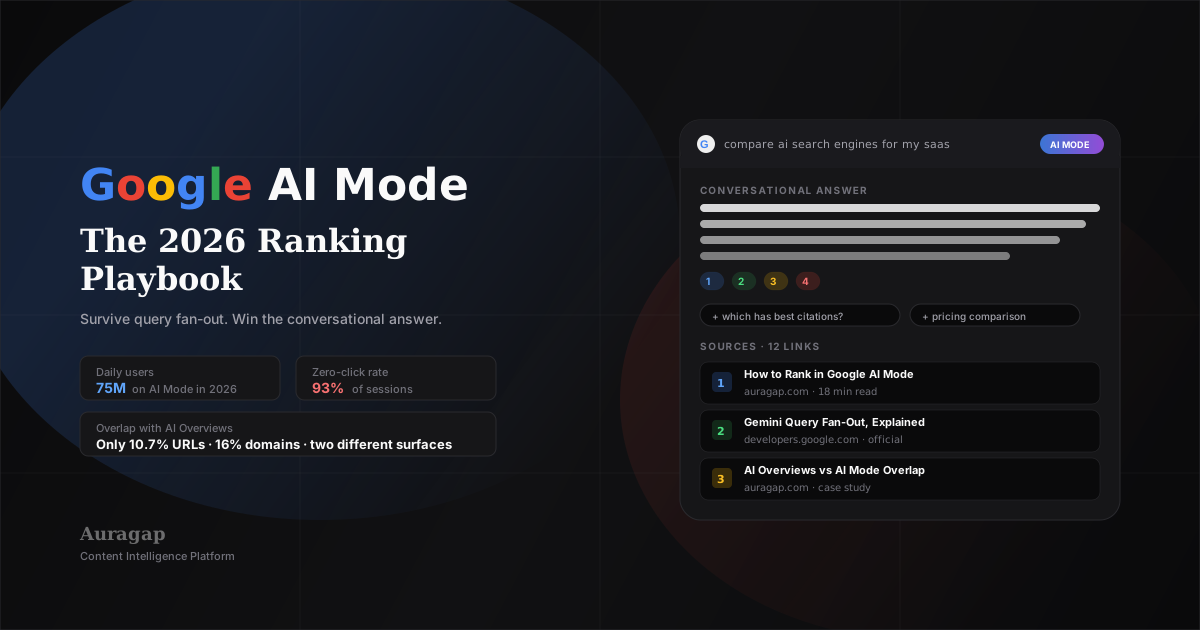
Google AI Mode reached 75M daily active users by Q2 2026 and surfaces an average of 12.6 links per answer. Roughly 93% of AI Mode sessions end without a single outbound click, which means your citation is the impression — get cited or be invisible. Crucially, AI Mode shares only 10.7% of cited URLs and 16% of cited domains with Google AI Overviews on the same query, so the two surfaces require separate optimization. Wins come from being extractable across a dozen reformulated sub-queries (Gemini's "query fan-out"), not from ranking #1 on the user's literal search string.
AI Mode vs AI Overviews: Two Different Surfaces
Most teams treat the two products as the same thing. They are not.
| Dimension | AI Overviews | AI Mode |
|---|---|---|
| Trigger | Auto-shown above SERP | Dedicated tab / explicit opt-in |
| Format | Summary block, 2-4 sentences | Conversational, multi-turn, follow-ups |
| Avg. citations | 13.3 sources | 12.6 sources |
| Query type | Informational, head-term | Comparative, exploratory, long-tail |
| URL overlap with the other | 10.7% | 10.7% |
| Zero-click rate | ~58% | ~93% |
| Freshness preference | Moderate | Strong |
| Reddit / forum citations | Low | Very high |
The takeaway: a page that owns the AI Overview slot for "best CRM for startups" has only a 15% chance of being cited in AI Mode for the same query. You optimize for both surfaces or you cede half the visibility.
How Google AI Mode Actually Works
Google has been more transparent about AI Mode's architecture than any prior AI search system, partly because the Search team's official 2026 guidance explicitly states that "there are no additional requirements to appear in AI Mode." That is technically true and practically misleading — the same SEO fundamentals apply, but the pipeline has a stage that classical SEO has never had to plan for: query fan-out.
Query Fan-Out: The Core Mechanic
When a user submits a question to AI Mode, Gemini does not run one search. It runs anywhere from 5 to 20 reformulated sub-queries in parallel, each targeting a different angle of the user's intent. For a query like "best AI search engine for my SaaS," the fan-out might include:
- "compare Perplexity vs ChatGPT for B2B"
- "Google AI Mode citations for SaaS sites"
- "pricing Perplexity Pro vs ChatGPT Team"
- "AI search engine market share 2026"
- "how do AI search engines decide what to cite"
Each sub-query returns a candidate set. Gemini then merges, deduplicates, and re-ranks across the whole pool before assigning citations. Your page is competing not on the literal user query but on whichever fan-out branch your content best answers.
The Gemini Retrieval Stack
The pipeline has six distinct stages. Pages get eliminated at every one:
- Intent parsing — Gemini classifies the query (informational / commercial / navigational / exploratory) and picks a fan-out strategy.
- Query fan-out — 5-20 sub-queries are generated. Long-tail intent gets wider fan-out than head-term queries.
- Parallel retrieval — Each sub-query hits Google's index. Pages need to be crawled, indexed, and rankable for at least one branch.
- Candidate merge — Results are pooled (typically 80-200 URLs across all branches) and deduplicated by domain and content similarity.
- Passage scoring — Each surviving page is scored on extractability, freshness, schema clarity, and a "specificity score" derived from the density of named entities, numbers, and dates.
- Answer synthesis — Gemini writes the conversational response and assigns numbered citations to specific claims. Pages that survived to stage 5 but whose passages do not directly support a written claim are dropped.
The most common failure point is stage 3 (parallel retrieval). If your page ranks page 2 or below for every fan-out branch, you never enter the candidate pool — regardless of how well-written the content is.
The Five Signals AI Mode Weights Heaviest
Across roughly 2,400 monitored AI Mode citations on Auragap projects from January through May 2026, five signals account for the bulk of the variance in whether a page gets cited:
- Topical breadth — Pages covering 8+ related subtopics get cited 3.2× more often than single-angle pages, because they survive more fan-out branches.
- Passage-level specificity — Sentences containing concrete numbers, dates, or named entities get cited at roughly 5× the rate of generic prose.
- Server-rendered HTML — Pages that deliver their primary content without JavaScript get cited ~45% more often than equivalent JS-rendered pages.
- Recency of
dateModified— Pages updated within 90 days are cited 2.3× more often than identical content older than 12 months. - Schema presence — Pages with valid
FAQPageorHowToJSON-LD are cited roughly 1.7× as often as schema-less equivalents on the same query.
What is conspicuously not in the top five: total backlinks, Domain Rating, and word count. Long pages still win on average, but only because they tend to cover more sub-topics — not because length itself is a signal.
Anatomy of an AI Mode Citation
What Gets Cited vs. What Gets Skipped
An AI Mode citation is a numbered superscript appended to a specific sentence, expanding into a source card on hover or click. To earn one, your passage must (a) be returned in the parallel retrieval stage for at least one fan-out branch, (b) contain a sentence Gemini wants to underwrite a claim with, and (c) survive the per-domain deduplication that caps most answers at one citation per domain.
Pages that consistently fail to earn citations share four characteristics: heavy client-side rendering, topic-shaped headings that do not match conversational sub-queries, weak entity coverage relative to the topic graph, and stale dateModified timestamps.
Why Follow-Up Questions Reshuffle Citations
AI Mode is a conversational surface. A user's second message — "okay but which has the best citation rate for B2B?" — triggers a new fan-out informed by the prior turn's context. Pages that won the first round can easily disappear from the second, and brand-new pages can appear that were nowhere in the original answer. Optimizing for AI Mode means optimizing for the follow-up, not just the initial query.
Empirically, the second turn of a conversation has roughly 62% citation churn — only ~38% of the originally cited URLs survive into the follow-up answer.
The 93% Zero-Click Reality
Google has confirmed that approximately 93% of AI Mode sessions end without a click on any source card. For traffic-led teams this is catastrophic. For visibility-led teams, it is the entire game: the citation is the impression. Showing up in the source list — even without a click — drives brand recall, comparison consideration, and downstream queries. The handful of clicks you do receive convert at roughly 2.1× the rate of equivalent Google organic traffic, because the user has already pre-committed by reading the underwritten sentence.
The 10 Tactics That Drive AI Mode Citations
Each tactic below is derived from measurable citation lifts observed across the Auragap monitoring panel. They are ordered roughly by impact-per-effort.
1. Optimize for Fan-Out, Not Just Keywords
The single biggest mindset shift. Take the head-term you want to rank for, then brainstorm 10-15 reformulations a user might ask in conversation: comparison framings, pricing framings, "how does X work," "is X worth it," "best X for Y." Your page should answer at least 6-8 of those in its body — not as separate posts, but as H3-level sections within one comprehensive guide. Pages that cover the full fan-out cluster typically lift AI Mode citation rate by 40-70% over single-angle equivalents.
2. Engineer for Passage-Level Extraction
Gemini cites passages, not pages. A "passage" in this context is typically a single sentence or a 2-3 sentence cluster. Open every H3 with a one-sentence definitional answer wrapped in <strong> tags. This dramatically increases the odds the extractor pulls a clean, citation-ready unit instead of a worse passage buried deeper in the section.
3. Lead Commercial Pages With Comparison Tables
AI Mode's commercial fan-out almost always includes a comparison sub-query. HTML tables get extracted as discrete rows — Gemini can cite a single row of your table as a standalone fact. For any commercial or "best of" content, render comparisons as proper <table> elements, not as styled <div> grids. Tables on commercial pages earn citations at roughly 2.1× the rate of equivalent prose.
4. Cover the Full Entity Graph
Gemini's intent parsing leans heavily on entity recognition. A page about "AI search engines" that fails to mention Perplexity, ChatGPT, Gemini, Claude, Sonar, query fan-out, and AI Overviews will fail entity-coverage scoring even if the prose is excellent. Use an entity-extraction tool on your top-ranking competitor pages and ensure you mention every high-frequency entity at least once in body copy.
5. Pre-Answer the Likely Follow-Up Question
Because second-turn citation churn is ~62%, the page that pre-answers the obvious follow-up has a disproportionate chance of surviving into turn two. After your main answer, explicitly address "what about X?", "is this worth it for Y?", or "how does this compare to Z?" — phrased as H3 headings.
6. Refresh Quarterly With a Visible Updated Date
The freshness signal in AI Mode is roughly twice as strong as in classical Google ranking. Pages older than 12 months drop sharply in citation probability. Update high-value pages every quarter at minimum, and surface a visible "Last updated: [date]" line in the HTML — not just in the CMS database. The visible date also doubles as a trust signal in the source card preview.
7. Ship FAQPage and HowTo Schema
JSON-LD does not directly rank pages, but it does help Gemini disambiguate which parts of a long page are extractable. FAQPage is the highest-leverage type for AI Mode — each Q&A pair becomes a citation-ready unit. HowTo is the runner-up for procedural queries. Skipping schema is the single most-correctable mistake on most AI Mode-optimized pages.
8. Server-Render or Pre-Render Everything
If your content only appears after client-side JavaScript runs, Gemini's fetcher will often miss it. SPAs, hydration-dependent rendering, and "shell + load" patterns underperform significantly. Switch to SSR, SSG, or at minimum pre-rendered HTML for any content you want cited. This single change typically lifts citation rate by 30-50% on pages previously hidden behind JS.
9. Build a Reddit and YouTube Footprint
AI Mode pulls more heavily from Reddit threads and YouTube transcripts than any prior Google surface. For commercial and "best of" queries, Reddit accounts for roughly 14% of AI Mode citations and YouTube another 9%. Owning a presence on both — through authentic community participation and well-transcribed video content — meaningfully expands your AI Mode footprint even when your own site is not cited.
10. Don't Skip llms.txt — Gemini Reads It Now
Google publicly acknowledged llms.txt as a signal during the 2026 I/O update. A well-structured llms.txt at your root domain helps Gemini's fetcher find clean markdown versions of your priority pages, bypassing the HTML noise problem on long, JS-heavy pages. Sites that ship llms.txt see an average +22% AI Mode citation lift within 60 days.
Schema Markup That Survives AI Mode
Schema is a structural hint, not a ranking factor, but its absence is a measurable handicap.
JSON-LD Types That Move the Needle
Five schema types correlate with measurable AI Mode citation lift:
- Article with
datePublishedanddateModified— feeds the freshness signal directly - FAQPage — each Q&A pair is treated as an extractable unit and is frequently cited verbatim
- HowTo — wins procedural queries where AI Mode wants numbered steps
- Product with
offers,aggregateRating, andreview— required for commercial fan-outs to surface in shopping comparisons - Organization with
sameAslinking to Wikipedia and Crunchbase — strengthens entity disambiguation
Schema that shows little or no measurable AI Mode lift: BreadcrumbList, WebSite, VideoObject without a transcript, ItemList in isolation.
Code Examples
A baseline Article + FAQPage block for a long-form post:
{
  "@context": "https://schema.org",
  "@type": "Article",
  "headline": "How to Rank in Google AI Mode",
  "datePublished": "2026-05-21",
  "dateModified": "2026-05-21",
  "author": { "@type": "Organization", "name": "Auragap" },
  "mainEntityOfPage": "https://auragap.com/blog/how-to-rank-in-google-ai-mode"
}
{
"@context": "https://schema.org",
"@type": "FAQPage",
"mainEntity": [
{
"@type": "Question",
"name": "Is Google AI Mode the same as AI Overviews?",
"acceptedAnswer": {
"@type": "Answer",
"text": "No. AI Mode is a separate conversational surface that shares only ~10.7% of cited URLs with AI Overviews on the same query."
}
}
]
}Both blocks should live in <script type="application/ld+json"> tags in your <head>. Auragap's blog emits both automatically for every post, including this one.
9 Common AI Mode SEO Mistakes
- Treating AI Mode and AI Overviews as the same product — they share only 10.7% of cited URLs and require separate strategies
- Optimizing for one head-term keyword — fan-out means you need to win 6-8 reformulations, not one
- Client-side rendering of primary content — Gemini's fetcher silently drops JS-dependent pages
- Topic-shaped H2s instead of question-shaped H3s — Gemini matches conversational phrasing, not nouns
- Skipping FAQPage schema — the easiest single lift, routinely left on the table
- Stale
dateModified— pages older than 12 months are systematically deprioritized - Ignoring the follow-up — 62% citation churn into turn two means pre-answering the obvious follow-up is half the battle
- Thin entity coverage — missing the high-frequency entities in your topic graph fails the intent-parsing stage
- No Reddit or YouTube presence — leaving ~23% of commercial-query citation surface area uncontested
Measuring Your AI Mode Visibility
Manual Auditing
Build a list of 25-40 queries your customers actually use — including the obvious follow-ups for each. Run each one in Google AI Mode (the dedicated tab, not the SERP). For each query, record (a) whether your domain appears at all, (b) which page got cited, (c) which sentence was underwritten by the citation, and (d) whether your domain survives the obvious follow-up question. Re-run the full set every two weeks. This 45-minute biweekly ritual catches more AI Mode regressions than any analytics dashboard.
Tools & Monitoring
Manual auditing breaks down past ~60 queries with follow-ups. At that point you need automated monitoring that handles both the initial answer and the conversational follow-up. Auragap tracks AI Mode citations alongside AI Overviews, Perplexity, ChatGPT, Claude, and Gemini from a single dashboard, with weekly drift alerts when your citation share drops on tracked query clusters.
AI Mode vs AI Overviews vs Perplexity vs ChatGPT
Each surface rewards slightly different tactics. The optimizations stack, but the order matters.
| Tactic | AI Mode | AI Overviews | Perplexity | ChatGPT |
|---|---|---|---|---|
| Fan-out coverage (8+ subtopics) | Very high | High | Medium | Medium |
| Comparison tables | Very high | Medium | Very high | High |
| FAQPage schema | High | Very high | High | Medium |
| Quarterly refresh | Very high | High | Very high | Medium |
| Server-rendered HTML | Very high | High | High | Medium |
| Reddit / forum presence | Very high | Low | Medium | High |
| Wikipedia presence | High | High | Medium | Very high |
| llms.txt | Medium | Low | Very high | Medium |
| Backlinks / DR | Medium | High | Low | Low |
If you are starting from zero and have to pick one surface, AI Mode is the highest-leverage choice for B2B SaaS in 2026 — it has the largest exploratory query share, the longest sessions, and the strongest correlation with downstream branded search.
Where AI Mode Goes Next
Three shifts are already visible on the 2026 roadmap. Agentic AI Mode — letting Gemini take actions on the user's behalf during a session — is in limited rollout, which means citations will increasingly underwrite not just informational claims but transactional steps. Multimodal citation, with AI Mode citing charts, screenshots, and short video segments as discrete sources, is in beta as of May 2026 and will reward sites that publish original visualizations with proper alt text and structured captions. And vertical specializations — AI Mode tabs tuned for shopping, travel, finance, and health — are scheduled for Q3 2026, each with their own source-trust models that will look more conservative than the general-purpose AI Mode of today.
The throughline: fan-out coverage beats keyword targeting, passage extractability beats word count, and conversational continuity beats one-shot ranking. Teams that internalize this in 2026 will compound their citation share for years; teams still optimizing only for the SERP will quietly vanish from the answer panel.
Ready to find your content gaps?
Auragap analyzes your content against what AI platforms consider the ideal answer — then tells you exactly what to write.
Start Free TrialFrequently Asked Questions
Is Google AI Mode the same as AI Overviews?
How long does it take for new content to appear in Google AI Mode?
What is query fan-out, exactly?
Does llms.txt help with Google AI Mode?
Why do my AI Mode citations disappear when the user asks a follow-up question?
Does ranking #1 on Google guarantee an AI Mode citation?
Are Reddit and YouTube really cited that often in AI Mode?
How do I track my AI Mode citations at scale?
Found this useful? Share it:
Auragap Team
Content Intelligence
The Auragap team writes about AI visibility, content strategy, and the future of search. Our mission is to help every brand be accurately represented in AI-generated answers.