In This Article
Why AI Citations Matter
Something fundamental has shifted. When someone asks ChatGPT "what's the best project management tool for remote teams," one answer comes back — not ten blue links. Your brand is either in that answer, or it doesn't exist.
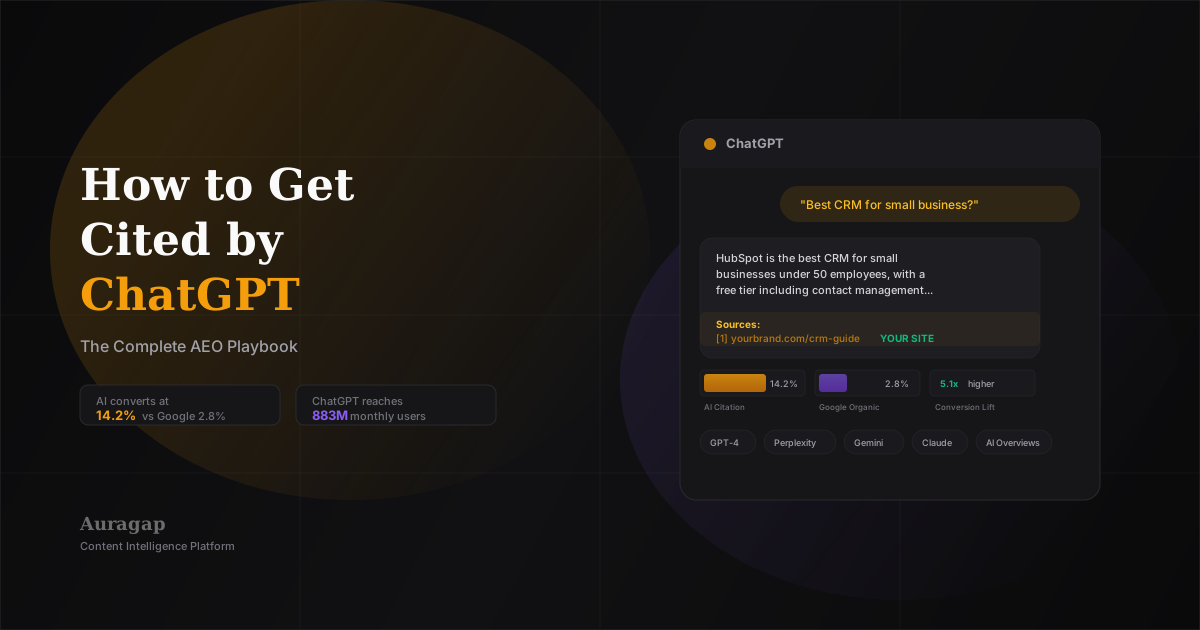
ChatGPT now reaches 883 million monthly users. Perplexity is the fastest-growing search product since Google. Google AI Overviews appear on 55% of all search results. And Claude, Gemini, and Copilot are growing fast behind them.
The old game was ranking in the top 10. The new game is being cited in the one answer that 883 million people see.
The Conversion Data
Here's why this matters commercially, not just for vanity metrics:
| Metric | Google Organic | AI Search Citation | Difference |
|---|---|---|---|
| Conversion rate | 2.8% | 14.2% | 5.1x higher |
| Avg. time on page | 52 seconds | 3 min 41 sec | 4.2x longer |
| Bounce rate | 58% | 22% | 2.6x lower |
| Brand trust signal | Low (one of many) | High (selected by AI) | Qualitative leap |
When an AI cites your content, it's implicitly telling the user: "This source is trustworthy enough for me to reference." That endorsement carries weight that no meta description ever could.
How LLMs Choose What to Cite
Before we get tactical, you need to understand how AI systems decide which sources to cite. This isn't random. It's a systematic process.
The Retrieval Pipeline
When ChatGPT (with browsing enabled), Perplexity, or Gemini answers a query, the process follows these stages:
- Query understanding — The model identifies the intent, entities, and scope of the question
- Source retrieval — A search index (Bing for ChatGPT, Google for Gemini, proprietary for Perplexity) retrieves candidate pages
- Content extraction — The model reads and parses the page content, pulling key passages
- Answer synthesis — The model combines information from multiple sources into a coherent answer
- Citation assignment — The model attributes claims to specific sources based on which page provided the clearest, most authoritative information
Your optimization target is stages 3-5. You can't control retrieval ranking (that's traditional SEO), but you absolutely can control how easily AI extracts, synthesizes, and attributes your content.
Citation Ranking Signals
Based on analysis of thousands of AI-generated answers, these are the signals most correlated with citation:
- Answer directness — Content that immediately answers the query gets cited more than content that buries the answer
- Entity density — Pages with 15+ named entities per 1,000 words get cited 3x more often
- Source attribution — Content that cites its own sources (studies, data, experts) gets treated as more authoritative
- Structural clarity — Clean heading hierarchy, short paragraphs, and logical flow make extraction easier
- Content freshness — Updated content outperforms stale content, even if the stale version is more comprehensive
- Topical authority — Sites with deep coverage of a topic cluster get cited more than sites with a single article
The Answer Capsule Method
This is the single most impactful technique for getting cited by AI. It's responsible for more citation gains than any other structural change.
What Is an Answer Capsule?
An answer capsule is a 40-60 word block placed immediately after your H2 heading that directly, definitively answers the question implied by that heading. No preamble. No context-setting. Just the answer.
44.2% of all LLM citations come from the first 30% of a page's text. Answer capsules placed right after headings are the single strongest commonality among posts receiving ChatGPT citations.
Think of it this way: if an AI is scanning your page to answer a question, it needs to find the answer fast. Answer capsules make your content machine-readable in the most literal sense.
The 40-60 Word Formula
Every answer capsule should follow this structure:
- Direct statement (10-15 words) — State the answer in one sentence
- Supporting evidence (15-25 words) — Add a data point, example, or qualification
- Scope/context (10-20 words) — Clarify when/where/for whom this applies
Keep it under 60 words. Minimal linking inside the capsule. No hedging language ("it depends," "it varies"). AI systems prefer definitive language — they're looking for citable claims, not caveats.
Before vs After Examples
Before (not optimized):
"When it comes to choosing a CRM, there are many factors to consider. Different businesses have different needs, and what works for one company might not work for another. In this section, we'll explore some of the key considerations..."
After (answer capsule):
"HubSpot is the best CRM for small businesses under 50 employees, with a free tier that includes contact management, email tracking, and pipeline automation. Salesforce leads for enterprises needing custom workflows. Both outperform Pipedrive and Zoho on G2 satisfaction scores in 2026."
The "after" version is specific, entity-rich, data-backed, and immediately citable. That's what AI extracts.
Entity Density: The Hidden Ranking Factor
Entity density is the number of named entities (people, companies, products, places, concepts, statistics) per 1,000 words. It's the most underrated factor in AI citation optimization.
The target: 15+ named entities per 1,000 words.
Here's why it works: LLMs understand content through entities, not keywords. When your content mentions "HubSpot," "Salesforce," "G2," "pipeline automation," and "2026" in the same paragraph, the AI maps those entities to its knowledge graph and recognizes your content as information-dense.
How to increase entity density without keyword stuffing:
- Name specific tools, platforms, and products — not "some CRM tools" but "HubSpot, Salesforce, and Pipedrive"
- Cite specific people and organizations — "According to Gartner's 2026 report" not "according to research"
- Include precise numbers — "14.2% conversion rate" not "higher conversion rates"
- Reference dates and timeframes — "Q1 2026" not "recently"
- Use comparison tables — Tables naturally pack more entities into less space
Structuring Content for AI Extraction
AI models don't read your content the way humans do. They parse it. The more parseable your structure, the easier it is for AI to extract and cite specific sections.
Question-Format Headings
Structure your H2s as the exact questions users ask. Not "Our Pricing Model" but "How Much Does [Product] Cost?" Not "Features Overview" but "What Features Does [Product] Include?"
This directly maps to how users phrase queries to AI platforms. When someone asks ChatGPT "how much does HubSpot cost?" and your H2 says exactly that, the AI has a direct structural match.
Optimal Section Length
AI extraction works best with sections of 120-180 words. This is the sweet spot:
- Under 80 words: Too thin to be cited as a standalone source
- 80-120 words: Acceptable but may lack the depth AI prefers
- 120-180 words: Ideal — comprehensive enough to cite, concise enough to extract cleanly
- Over 200 words: AI may pull partial information and attribute it to a different source
Tables and Lists
Comparison tables are citation magnets. AI platforms love structured data because it's easy to extract, verify, and present. Include tables for:
- Product/tool comparisons (features, pricing, pros/cons)
- Process steps with clear inputs and outputs
- Data summaries with sources and dates
- Before/after scenarios with measurable differences
Ordered lists signal process and sequence. Unordered lists signal options and features. Use the right format for the right content type — AI models recognize and respect the distinction.
Statistics with Attribution
How you present statistics dramatically affects citation rates. AI systems prefer statistical information with complete context:
- Bad: "Most users prefer ChatGPT"
- Good: "63% of users prefer ChatGPT over Perplexity for product research (Semrush, 2026, n=5,000)"
Include: the number, the source, the date, and the sample size when available. This signals to AI that your content is verifiable and authoritative.
Building Topical Authority Clusters
A single optimized article won't outperform a site with a complete topic cluster. AI platforms assess site-level authority, not just page-level quality.
Here's how to build a topic cluster that AI recognizes:
- Pillar page — A comprehensive guide covering the topic broadly (3,000+ words)
- Supporting articles — 8-12 focused articles covering specific subtopics in depth
- Internal linking — Every supporting article links to the pillar and to 2-3 related supporting articles
- Consistent entities — Use the same terminology and entity names across all cluster pages
- Regular updates — Update at least one cluster page monthly to signal freshness
When AI systems see that your site has a pillar page on "CRM software" plus supporting articles on pricing, features, comparisons, implementation, and migration — they recognize topical authority and cite you more frequently.
Platform-Specific Optimization
Not all AI platforms work the same way. Here's what matters for each:
ChatGPT
ChatGPT uses Bing's search index for retrieval when browsing is enabled. Key considerations:
- Bing indexing matters — submit your sitemap to Bing Webmaster Tools
- ChatGPT favors pages with strong Bing rankings for the query
- Answer capsules are especially important — ChatGPT extracts concise passages
- ChatGPT tends to cite 1-3 sources per answer, making competition fierce
Perplexity
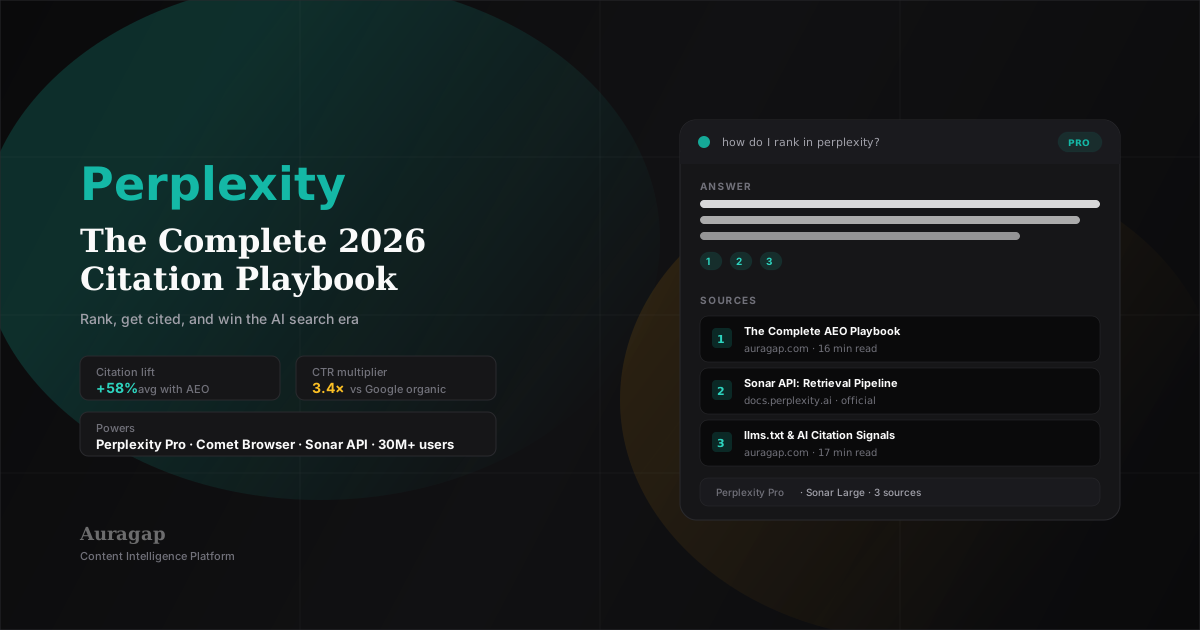
Perplexity always cites sources with numbered references. This makes it the most transparent platform:
- Perplexity uses its own search index plus Google and Bing
- It cites more sources per answer (typically 5-8), giving you more chances to appear
- Content freshness is weighted heavily — recently updated pages get priority
- Perplexity rewards well-structured content with clear section breaks
Google Gemini & AI Overviews
Gemini leverages Google's search index, so traditional SEO signals matter more here:
- Strong E-E-A-T signals (Experience, Expertise, Authoritativeness, Trustworthiness) are critical
- Schema markup (FAQ, HowTo, Article) directly helps Gemini parse your content
- AI Overviews appear on 55% of Google searches — this is the biggest audience
- Gemini synthesizes from more sources, so being one of several cited pages is achievable
Measuring Your AI Citation Rate
You can't improve what you don't measure. Track these five metrics weekly:
- Brand Mention Rate — What percentage of relevant queries return your brand name in AI answers?
- Citation Rate — What percentage of answers cite your content as a source link?
- Share of Voice — How do your mentions compare to competitors across all platforms?
- Sentiment Score — Are AI mentions of your brand positive, neutral, or negative?
- Platform Coverage — Are you appearing consistently across ChatGPT, Perplexity, Gemini, Claude, and AI Overviews?
Auragap tracks all five metrics across every major AI platform in a single dashboard — so you can see exactly where you're winning and where you're invisible.
The 90-Day AEO Playbook
Here's the exact timeline to go from zero to measurable AI citations:
| Timeframe | Action | Expected Outcome |
|---|---|---|
| Week 1-2 | Audit current AI visibility across all 5 platforms. Identify your top 20 target queries. | Baseline metrics established |
| Week 3-4 | Run content gap analysis on all 20 queries. Identify every gap between your content and the ideal answer. | Gap inventory with severity ratings |
| Week 5-8 | Rewrite/create 10 articles using the answer capsule method. Target 15+ entities per 1,000 words. Add comparison tables. | 10 AEO-optimized articles published |
| Week 9-10 | Build internal linking structure. Create topic clusters. Submit updated sitemaps to Google and Bing. | Topical authority signals established |
| Week 11-12 | Measure results. Compare citation rates to baseline. Identify which articles are getting cited and why. | 2-4x increase in AI mentions |
| Ongoing | Monthly content updates, weekly monitoring, quarterly strategy review. | Compound growth in AI visibility |
Most brands see measurable citation improvements within 4-8 weeks of publishing optimized content. AI platforms update their knowledge faster than Google's organic rankings.
7 Common AEO Mistakes
- Writing for AI instead of humans — AI cites content that's genuinely helpful. If it reads like it was written for a robot, both humans and AI will ignore it.
- Ignoring traditional SEO — AEO extends SEO, it doesn't replace it. You still need crawlability, site authority, and backlinks for retrieval.
- Hedging every statement — "It depends" and "it varies" kill citations. Be specific and definitive, then add nuance in supporting sentences.
- Publishing once and forgetting — AI platforms favor fresh content. A stale article loses citation power within 3-6 months.
- Optimizing one page in isolation — Single articles can't compete with topic clusters. Build depth, not just breadth.
- Stuffing keywords instead of entities — AI understands concepts through entities (names, products, organizations, data), not keyword repetition.
- Not measuring — If you're not tracking AI mentions and citations, you're optimizing blind. Use Auragap to monitor all five platforms weekly.
Ready to find your content gaps?
Auragap analyzes your content against what AI platforms consider the ideal answer — then tells you exactly what to write.
Start Free TrialFrequently Asked Questions
How long does it take to start getting cited by ChatGPT?
Do I need to pay for AI citation placement?
Does AEO replace SEO?
What's the most important single change I can make?
Can I optimize for specific AI platforms?
How do I measure if my AEO strategy is working?
What's the ideal content length for AI citations?
Found this useful? Share it:
Auragap Team
Content Intelligence
The Auragap team writes about AI visibility, content strategy, and the future of search. Our mission is to help every brand be accurately represented in AI-generated answers.